

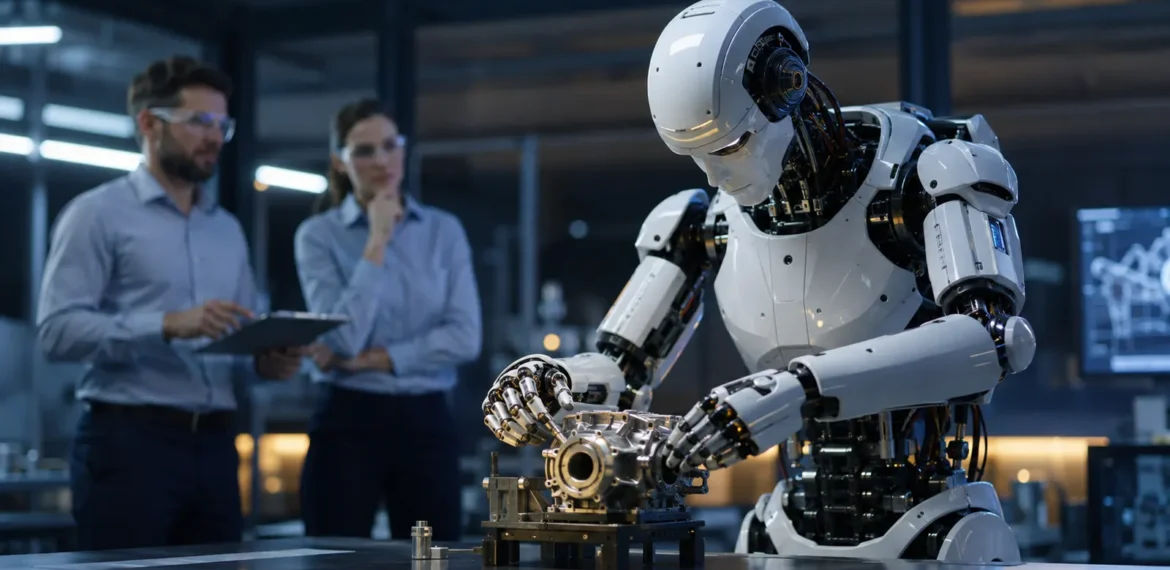
Embodied Intelligence: How AI Learns to Act in the Physical World
Embodied Intelligence: How AI Learns to Act in the Physical World
 Cody Matthews
Robotics gives artificial intelligence a body. Every prediction must ultimately survive contact with friction, uncertainty and the physical world.
A robot combines sensing, state estimation, planning and control. Cameras, lidar, force sensors and other instruments provide incomplete observations. The system must infer what is happening, choose an action and execute it safely through hardware.
Learning perception
Neural networks can identify objects, estimate depth and interpret scenes. Multimodal models can connect language with visual information, enabling instructions such as placing a specified object in a location.
Perception remains uncertain. Transparent objects, unusual lighting and partial occlusion can produce errors. Physical systems need ways to detect uncertainty rather than acting as though every classification were correct.
Planning under constraints
A robot must translate an objective into feasible movements. Classical planning uses explicit models and constraints. Learning-based methods can acquire policies from demonstrations or reinforcement, while hybrid systems combine learned perception with structured planning and control.
The physical environment imposes non-negotiable limits: joints have ranges, objects have weight and collisions have consequences.
The simulation-to-reality gap
Simulation allows robots to practise rapidly without damaging equipment, but simulated physics is an approximation. A policy may exploit details of the simulator that do not exist in reality.
Researchers use domain randomisation, calibration and real-world fine-tuning to improve transfer. Evaluation must still occur on physical hardware under varied conditions.
Learning from human demonstrations
Imitation learning can reduce the need to specify every rule. A person demonstrates a task and the robot learns patterns linking observations to actions.
Demonstrations do not cover every failure. A robot may reproduce incidental behaviour or become confused outside familiar trajectories. Safe deployment needs constraints, monitoring and recovery procedures.
General-purpose robotics remains difficult
Humans transfer knowledge between tasks with remarkable flexibility. Robots typically remain strongest in controlled environments or carefully bounded tasks. Foundation models may improve generalisation by learning from diverse data, but physical reliability is a higher standard than producing a plausible digital response.
Embodied intelligence as a scientific test
Robotics exposes whether an AI system can maintain a useful model of a changing world and act with consequences. It also forces researchers to integrate disciplines: mechanical engineering, control theory, perception, machine learning and human factors.
Progress is real, particularly in warehouses, manufacturing, laboratories and specialised navigation. The path to broadly capable robots, however, depends on robustness and safety—not only on demonstrations of isolated success.
The reality gap
Simulation generates experience without damaging hardware, but no simulator fully captures friction, lighting, deformable objects, sensor noise and human behaviour. Domain randomisation varies simulated conditions, while real-world fine-tuning adapts a policy after deployment. Neither removes the need for physical testing.
Generalisation is more than a demonstration
A video may show one successful run selected from many attempts. Scientific evaluation reports success rates, failures and performance on unseen objects and environments. Long tasks amplify small errors: if each of ten independent steps succeeds 95% of the time, the chance of completing all ten is only about 60%.
Safety needs layers
Learned behaviour should operate within collision avoidance, force and speed limits, workspace boundaries, emergency stops and human supervision. Uncertainty can trigger a safe stop or request for help. Networked robots also require authentication, secure updates and incident logging.
- Use repeated trials and disclose unsuccessful runs.
- Separate training environments from novel tests.
- Measure completion, intervention and safety violations.
- Test recovery from disturbances.
- Document hardware, sensors and software versions.
Progress depends on connecting learned representations to control engineering and systems designed to fail safely.


