

AI in Cybersecurity: Where Automation Ends and Human Judgement Begins
AI can accelerate detection and investigation, but dependable cyber defence still requires context, validation and accountable human decisions. …
 Amelia Brooks
Artificial Intelligence and the Scientific Method
How AI changes hypothesis generation, literature review and experimentation while reproducibility, causal reasoning and independent replication remain vital. …
 Sean Chung
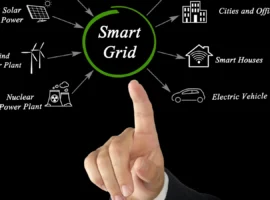
Artificial Intelligence and the Future of Energy Systems
How AI can support power forecasting, grid operations and efficiency—and how reliability, cybersecurity and environmental impact should be …
 Cody Matthews
Embodied Intelligence: How AI Learns to Act in the Physical World
Why embodied AI is harder than digital intelligence: simulation transfer, long-horizon reliability, physical safety and meaningful robotics benchmarks. …
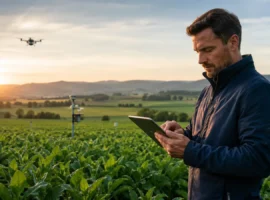
Artificial Intelligence in Agriculture: From Sensors to Decisions
A scientific look at AI in agriculture, from remote sensing and crop models to field validation, farmer autonomy …
 Anthony Benner
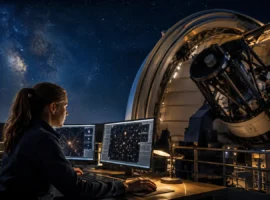
Artificial Intelligence in Astronomy: Finding Signals in the Sky
How astronomers use AI to find exoplanets, transients and anomalies—and the validation required to turn an algorithmic signal …
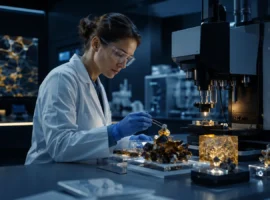
AI and the Search for New Materials
How AI searches materials space, guides experiments and accelerates discovery while synthesis, durability and independent validation remain essential. …
 Alisha Nettekoven
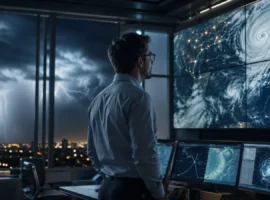
AI Weather Forecasting: Learning the Future of the Atmosphere
How AI weather forecasting works, how forecast skill and uncertainty are evaluated, and why physics, expert review and …
 Nicole Dijkstra
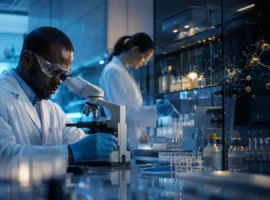
How Artificial Intelligence Is Changing Drug Discovery
How AI supports drug discovery, where computational predictions fail, and why prospective experiments remain the standard for scientific …
 Michelle Laurant
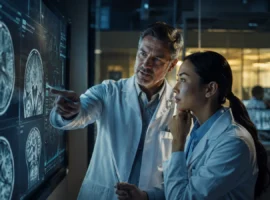
Artificial Intelligence in Medicine: From Prediction to Clinical Evidence
A scientific guide to medical AI: clinical validation, bias, calibration, privacy, human oversight and the evidence needed before …
 Cristian Silva

