

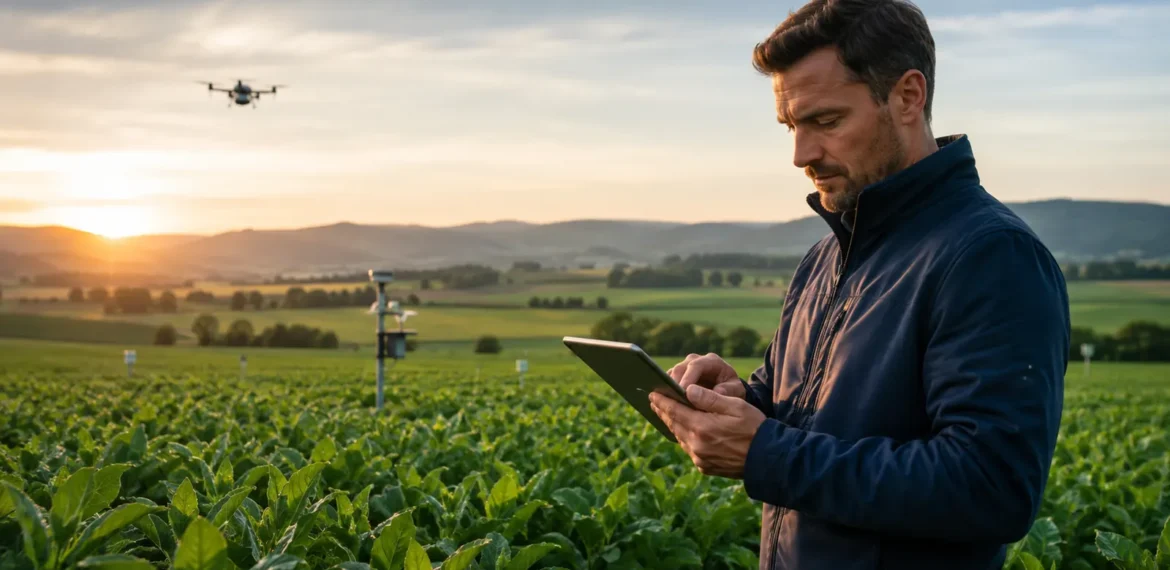
Artificial Intelligence in Agriculture: From Sensors to Decisions
Artificial Intelligence in Agriculture: From Sensors to Decisions
 Anthony Benner
Agricultural AI operates where biological variation, weather, economics and local knowledge meet. Its usefulness therefore depends as much on context and measurement as on model performance.
Applications include crop monitoring, disease detection, yield estimation, irrigation management, weed identification and livestock observation. Data may come from satellites, drones, field sensors, machinery, weather stations and farm records.
Seeing patterns across the field
Computer-vision systems can analyse plant images for visible signs of disease or nutrient stress. Remote-sensing models can map vegetation indices and estimate changes across large areas.
Visual similarity creates uncertainty. Different diseases may produce similar symptoms, and lighting, crop variety or growth stage can affect appearance. Laboratory confirmation or agronomic assessment may still be required.
Precision inputs and uncertain environments
AI can help estimate where water, fertiliser or treatment may be most useful. More targeted application has the potential to reduce waste and environmental impact.
Recommendations must account for uncertainty in sensors, forecasts and soil conditions. Optimising for immediate yield alone may conflict with long-term soil health, water availability or biodiversity. The objective function is therefore an agricultural and social choice, not merely a technical one.
Generalisation is a central challenge
A system trained in one region may perform poorly elsewhere because climates, crops, pests and farming practices differ. Even within one farm, conditions change between seasons.
Scientific evaluation should include multiple locations and years. Researchers need to report not only average performance but also failure conditions and the populations of farms represented in the data.
Access determines who benefits
AI may support smallholders where specialist advice is scarce, but only if tools function with available devices, languages and connectivity. Data ownership is also important: farmers should understand how operational data are used and who benefits from aggregated information.
Automation does not remove agronomy
A recommendation can be statistically reasonable and still be inappropriate for a particular field. Farmers and agronomists contribute contextual knowledge that may not exist in the dataset, including recent interventions, local constraints and observations that were never digitised.
The strongest systems combine measurements with that expertise. They make evidence easier to interpret while leaving room for informed challenge.
Measuring outcomes that matter
Agricultural AI should be evaluated by more than predictive accuracy. Relevant outcomes may include water use, chemical application, yield stability, labour, profitability and environmental effect.
AI can make agriculture more observable and responsive. Its scientific and social value will depend on whether those capabilities remain reliable across real environments and accessible to the people making decisions on the land.
From prediction to a farm decision
A model may detect leaf damage in curated images yet fail under different lighting, cultivars or disease stages. Detection matters only when it leads to an appropriate action. A decision-support system should account for crop stage, weather, treatment cost and the consequence of waiting. False alarms can increase pesticide use; missed detections can let an outbreak spread.
Local data and changing climate
Soil, climate, equipment, regulation and farm economics vary sharply. Models trained on large mechanised farms may not transfer to smallholders, while satellites can struggle with clouds or small mixed plots. Climate change introduces further shift as historical relationships between weather, pests and yield weaken.
- Represent the intended region, crop, season and farming system.
- Measure performance under field rather than controlled conditions.
- Test whether advice improves yield, inputs or resilience.
- Give farmers control over their data and recommendations.
- Include connectivity, maintenance, cost and unequal access.
The best evidence links predictions to measured agronomic and environmental outcomes while respecting the knowledge and autonomy of the people using them.


